the steering layer
Humans interact as someone. We understand what is going on, and we hold a faint intuition of the next action that gets us to the result we want. We expect AI systems to be so strong that, with a little steering, they would do the same but better.
But the design we create and test for a system doesn't hold at runtime. AI gets put in real positions like CS representatives, specific characters, companions, where we test if it works: feels natural, gets the job done, reads like the person we would want.1Humans superimpose our own social processes onto anything we use language with. When the system on the other side does not run those processes, it is set up for failure (Nass, Steuer & Tauber 1994, CHI; Reeves & Nass 1996, The Media Equation). Yet at runtime the same system turns unpredictable, eventually making mistakes no person would make, forgetting facts, avoiding basic tasks, switching personality mid-chat.2Persona adherence decays within about eight turns, and larger models drift more, with interaction performance dropping about 39% as exchanges turn multiturn (Li et al. 2024, COLM 2024; Choi et al. 2024; Laban et al. 2025, ICLR 2026 Outstanding Paper). As conversations go on, the statelessness of AI causes it to lose track of what situation it is in and who it is supposed to be. Every unnatural move then gets a new instruction in the system prompt, and every mistake gets a new rule added as well, but these solutions don't hold and start diluting the design we created.3The dilution is mechanical: content in the middle of a long prompt gets used far less than content at its edges, so the longer the accumulated instructions grow, the less each one is actually used, and each added rule dilutes the ones before it (Liu et al. 2023, Lost in the Middle, TACL 2024).
System prompts aren't enough for AI systems that are supposed to act like someone within a role: more instructions don't solve the statelessness underneath that is causing AI to be unaware of the situation or itself.
To steer interactions to how they should feel and where they should go, we need to give the AI a continuous sense of what is going on and who it is.4Giving a system a held sense of situation and self follows cognitive architectures, where the self-model and the world-model are persistent structures the system consults on every step of processing (Bach 2009, Principles of Synthetic Intelligence, Oxford University Press).
stack agnostic steering
The solution needs to fit within the stack you already have and know could work. Your model, weights, tools, and skills stay, only the trial-and-error patched system prompt goes. We steer using a harness that plugs between the user and the model to interpret inputs with the situation and design in mind and to check outputs. Emulating a world model as we laid out here: AI needs to understand the world of human interactivity.
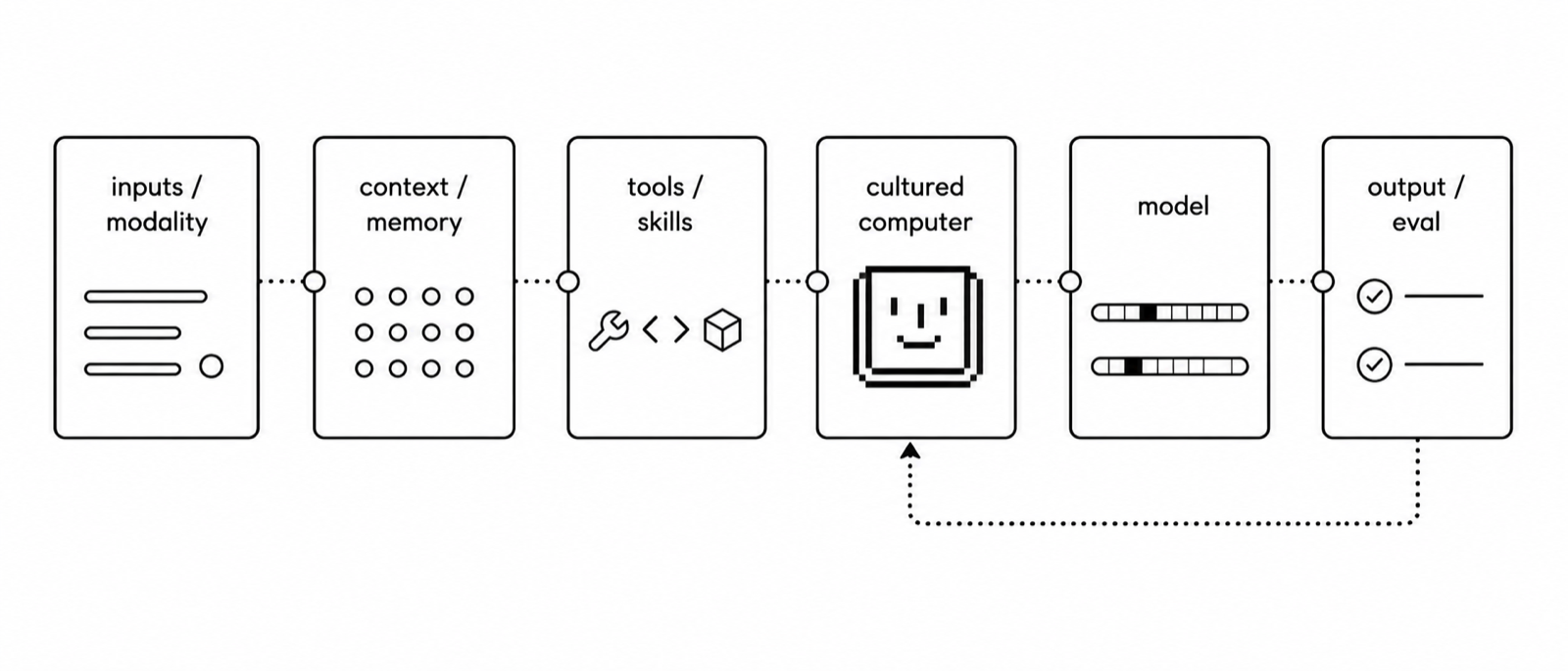
injecting awareness and direction on runtime
Per turn, the harness does three things. It keeps an awareness of the interaction state. It holds the behavior you designed, who your system is. And it injects only the per-turn relevant pieces of both into the model. Then come two more: it measures the result, and over time it improves itself from what it measured. The rest of this page walks through those five parts in order.

We give the AI a situational awareness by tracking the interaction states in full. Most drift happens as conversations go on: that statelessness lets the situation slip, until the system is answering a conversation it is no longer in. An interaction state is what a conversation actually consists of: the type of situation this is, the goal the two sides share, which part of the conversation we are in and what subpart of that, who has done what so far, what the tools have done and are doing, what we assume the other wants or expects, the environment the exchange sits in, how the moods have shifted along the way, and other things a person would track without noticing.5A decomposition based on what humanities researchers already assume people track and model internally: language use as joint action on common ground, acting on goals both sides share, and modeling what the other knows and wants (Clark 1996, Using Language; Tomasello et al. 2005, Behavioral and Brain Sciences; Baron-Cohen, Leslie & Frith 1985, Cognition).
The harness observes and records that state, updates it every turn, and checks and corrects it along the way. Each turn adds to the record, so the understanding grows as the conversation does. Turn two hundred reads from the record as clearly as turn two. In production, Sight is where you see it.
To react appropriately to the interaction state, we design who the system is supposed to react as. The design runs three levels deep. Identity is who the system is with multiple facets that give it a depth and logical responses in different situations. The role is what it is there to do, divided into subroles and their tasks. The history is what it has done and been, with this user across sessions, the past it stays consistent with. The result is a consistent, coherent experience, and a role filled effectively.
The state and the design together hold far more than any reply needs, so injection is a selection: enough of the situation to understand the incoming message, enough of the self to answer it in character,6Similar to the persona-theory approach, we position the LLM in the right spot of latent space to respond lucidly, then keep that positioning loosely in place so the interaction stays coherent (Shanahan et al. 2023, Nature; Chen et al. 2025, Persona Vectors, arXiv:2507.21509; Lu et al. 2026, The Assistant Axis, arXiv:2601.10387). assembled fresh and small every turn. The model already receives the flow of the conversation; what it lacks is the compressed idea of it. Each response comes out coherent, because the model knows what this moment follows; predictable, because it reacts as designed; natural, because it improvises from an understanding instead of reciting instructions. (See how we do the context engineering.)
This process has proven to be more natural and more effective, being frontier on multiple benchmarks.

measuring and improving
After the reply, the harness measures what the turn actually did. It updates the interpretation: feeding back into the awareness. It catches wrong outputs that need rerunning: a response that breaks the design or the flow of the conversation can be caught and redone before it costs the interaction. And it saves: the turn, its state, and its result persist as a record.

After a conversation has run its course and we know the outcome, the harness can self-improve. It reflects on the interaction and tries to spot places where it went wrong or where it could have done even better. With the saved states and trajectory, it changes some of the design, some of the injection mechanics, or even some of the way it calls tools, to check whether those breakages and weaknesses go away. If a tweak solves the problem, it attempts the solution on known successful interactions to make sure it is not overfitting or breaking other things. Learnings like this allow the steering to self-improve and to share what it learned across sessions, deployments, and even industries.7Self-improvement of this kind is proven separately from our product: agents improve by reflecting on their own transcripts and storing the lessons, iterative self-critique lifts output quality, and reflective prompt evolution can outperform reinforcement learning while touching no weights (Shinn et al. 2023, Reflexion, NeurIPS 2023; Madaan et al. 2023, Self-Refine, NeurIPS 2023; Agrawal et al. 2025, GEPA).
The compass is your KPIs; the result is month six running better than month one, on the same model. The breakage seen along the way becomes benchmarks and the next generation of interaction systems: the field.
endnotes
- Nass, Steuer & Tauber (1994). Computers Are Social Actors. CHI '94, 72–78. Reeves & Nass (1996). The Media Equation. Cambridge University Press / CSLI.
- Li, K. et al. (2024). Measuring and Controlling Instruction (In)Stability in Language Model Dialogs. COLM 2024, arXiv:2402.10962. Choi et al. (2024). Examining Identity Drift in Conversations of LLM Agents. arXiv:2412.00804. Laban, Hayashi, Zhou & Neville (2025). LLMs Get Lost in Multi-Turn Conversation. arXiv:2505.06120. ICLR 2026 Outstanding Paper.
- Liu et al. (2023). Lost in the Middle: How Language Models Use Long Contexts. TACL 2024, arXiv:2307.03172.
- Bach, J. (2009). Principles of Synthetic Intelligence. Oxford University Press.
- Clark, H. H. (1996). Using Language. Cambridge University Press. Tomasello et al. (2005). Understanding and sharing intentions: the origins of cultural cognition. Behavioral and Brain Sciences 28(5):675–691. Baron-Cohen, Leslie & Frith (1985). Does the autistic child have a “theory of mind”? Cognition21(1):37–46.
- Shanahan, McDonell & Reynolds (2023). Role play with large language models. Nature 623:493–498. Chen et al. (2025). Persona Vectors: Monitoring and Controlling Character Traits in Language Models. arXiv:2507.21509. Lu et al. (2026). The Assistant Axis. arXiv:2601.10387.
- Shinn et al. (2023). Reflexion: Language Agents with Verbal Reinforcement Learning. NeurIPS 2023, arXiv:2303.11366. Madaan et al. (2023). Self-Refine: Iterative Refinement with Self-Feedback. NeurIPS 2023, arXiv:2303.17651. Agrawal et al. (2025). GEPA: Reflective Prompt Evolution Can Outperform Reinforcement Learning. arXiv:2507.19457.